With
some help from Hebron, CT, town officials and local historians,
I've tried to develop a picture (so to speak) of the distillery's
history. If you can help, please contact
me.
Shortly
after prohibition ended in December 1933, Yorkshire Distillers
was incorporated (Feb 25, 1935), by David Hayes, President;
Francis Cox, Treasurer; and John Hayes, Secretary; for the purpose
of manufacturing, bottling, and distributing various alcoholic
liquors such as gin and whiskey. David Hayes had previously
bought the property and buildings from the Amston Lake Company.
It seems to me that Yorkshire was immediately in trouble as
the Colchester Lumber and Coal Co. had a lien on the property
by Sep 1936 for failure to pay a bill for constructing "a certain
building" on the site.
A
receiver was appointed in Dec 1936, and the Yorkshire property
was sold to United Distillers Products Corp. of North Bergen,
NJ, in July 1937. Nat Tulley Semel (pronounced "Zemel")
was President of United Distillers by 1946 when they applied
for State liquor permit renewal as a manufacturer. At least
some of the liquor was labeled under the "Old Amston"
brand, but Mr. Semel was quite creative in naming his products:
I heard from former Amston resident Wallace Brodeur that one brand was "Antedeluvian"
but haven't yet seen that label.
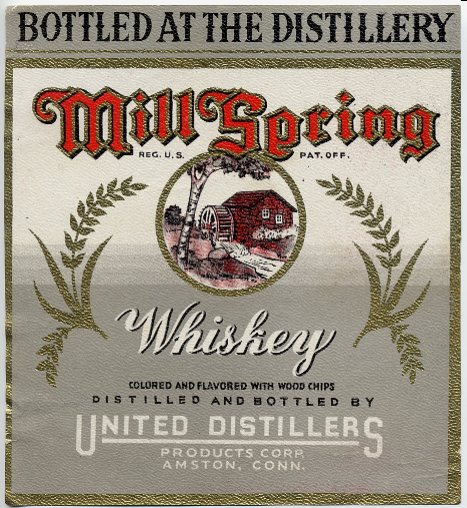
Click
here to view a collection of United Distillers labels.
(Thanks
to Amston's Elaine Wallace for the loan of these labels for scanning.)
There
was a deed transferring the property from United Distillers
to Semel in 1952. This is a bit confusing to me because when
United Distillers went belly up in 1961, the property was deeded
to the Florence Operating Corporation, the sole stockholder
of which was... Nat Tully Semel.
Florence
Operating Corporation dissolved in 1968 and the land was sold
for $1 to Nat Semel's estate. The estate then sold the property
to Joseph Seaha and Carol Danovich of Meriden (and I stopped
following the trail).
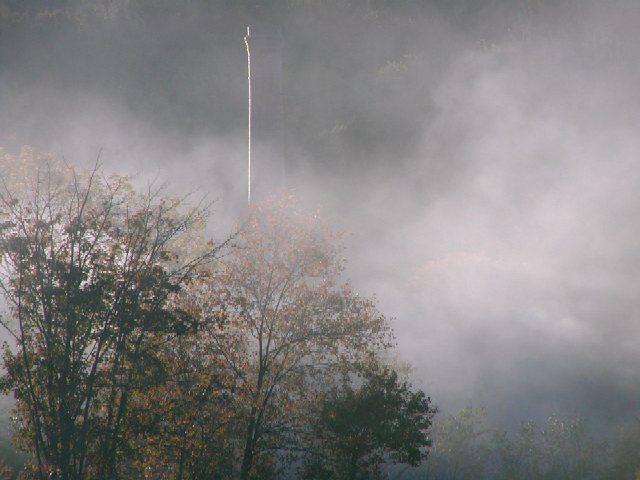
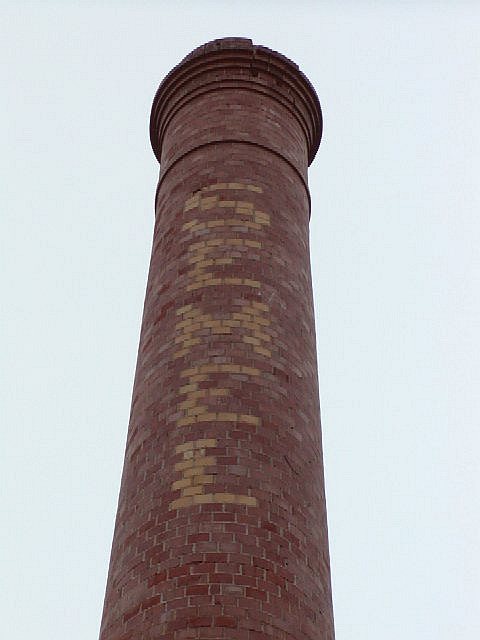
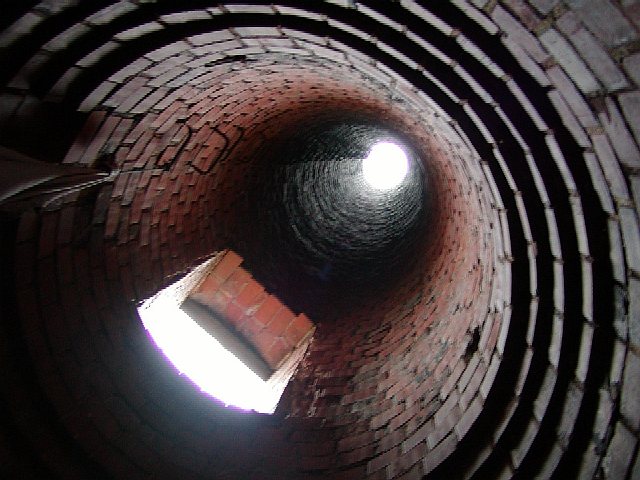
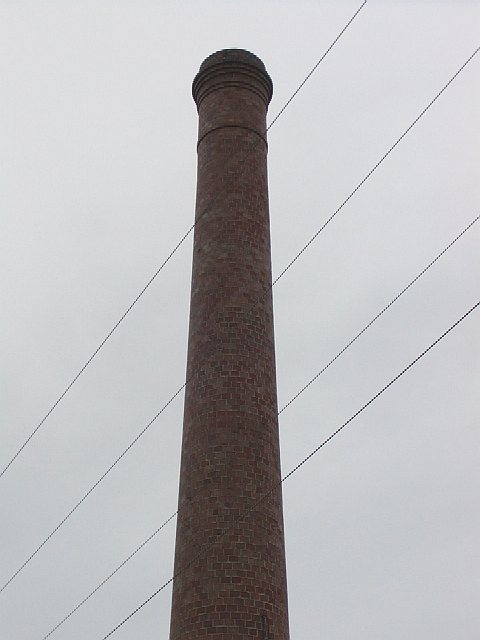
When
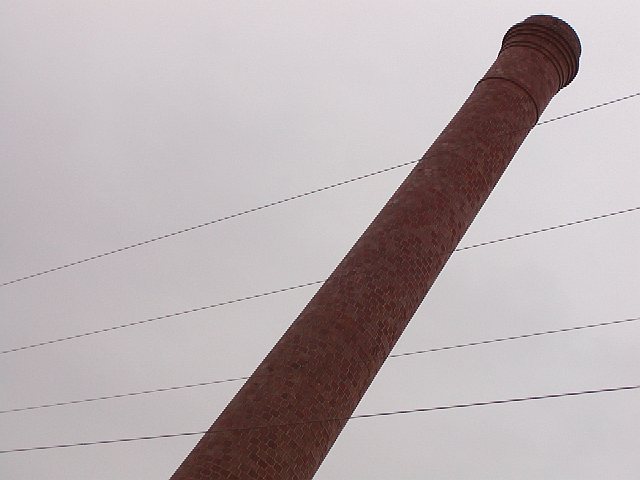
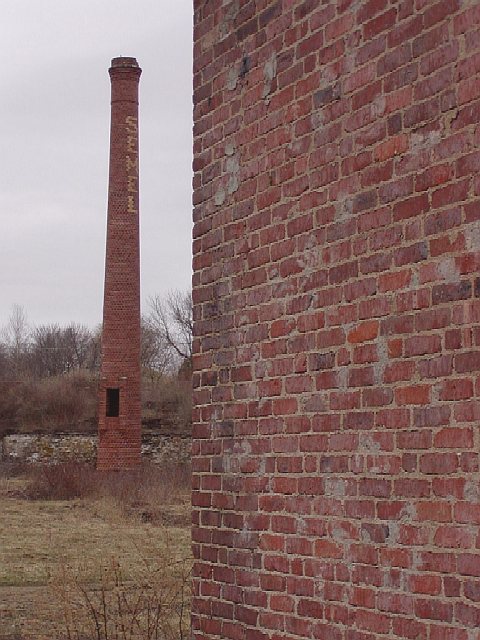
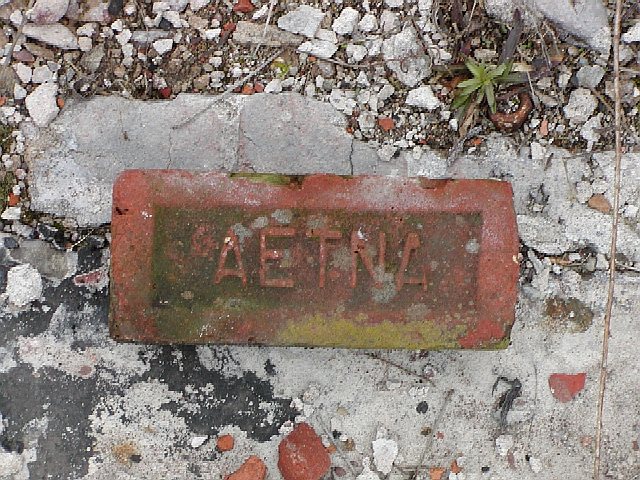
was the chimney built? Since the name "SEMEL" is an
integral part of the brick work, I'd have to say it was either
built during the time that N. Tully Semel was President of United
Distillers, or before he died (while he owned Florence Operating
Corp). There is no indication that Semel was connected to Yorkshire.
And because Hebron didn't issue construction permits back then,
I can't just look it up. I don't know when Semel took the role
of United Distiller's President, so for now I'll use the earliest
date for the chimney as when United Distillers took over from
Yorkshire. That gives a range of 1937 to 1968.
(June
2009 update. I've just had a phone call from Mildred Rubin who
worked at United Distillers starting in 1939 until the mid-'40s.
United Distillers was Nat Semel's company from its inception.
Prior to 1939, Nat Semel had a "rectifying plant" in New Jersey.
He bought alcohol from others and used it as a base for his
own beverages. The Amston plant included a distillery plus the
bottling facility. Apparently, the distillery was over by the
chimney. The building still standing, barely, was where the
staff lived. I believe it also housed offices and some production
functions. Nat's primary customers were distributors who he
supplied with private label stock. During WWII, Semel made alcohol
for the government. "Florence Manufacturing Co." was
named for Nat's daughter. Nat had two other children - Gloria
and Norman - by his first wife, Ruth. After Ruth's death, he
married Janet Zeleznicky of Salem, CT. They had two children,
Nathaniel Tully Semel, Jr., and George Myron Semel. Thank
you, Mildred!)
Thanks
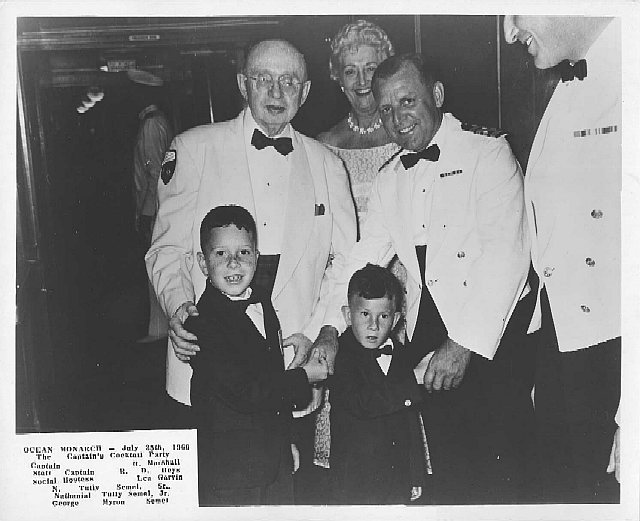
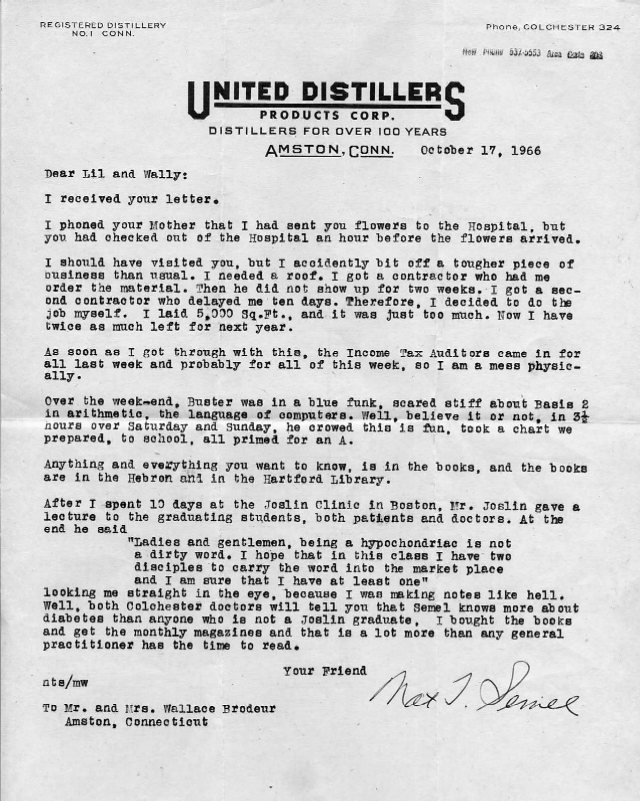
to Wally Brodeur, formerly of Amston, I can share two 1966 documents
shedding a little light on Nat Tully Semel, Sr.
- Photo of Nat with sons Nat Tully Semel Jr., and George Myron Tully,
taken while on a cruise.
- A
letter from Nat to Lil and Wally Brodeur.
It
looks like the businesses on the site were rarely healthy -
if the list of liens, foreclosures, and dissolutions are any
indication. And from other town records and what historians
have told me, that trend has continued to the present. (Today,
the property has the address 612 Church Street.)
The
distillery site is in a section of Hebron called Amston. (Indeed,
there is an Amston, CT, post office.) Phineas Turner began buying
land in the area in 1853 and had established a cluster of water-powered
factories making silk ribbon and fringe by 1888. These factories
were closed by 1907. Turner died in 1903. Charles Ams (not Ames
as the name is sometimes spelled) purchased the factory complex
and North Pond water rights in 1912. Among his manufacturing
ventures was the Ams-Sterling motor car, but it was not a success
and production had ceased by 1917.
During
Turner's time, a community of workers and support businesses
developed close to the factories. This became Turnerville, then
Amston after ownership of the factories changed. With the decline
of manufacturing in the 1930s, North Pond (now Amston Lake)
was developed as a summer vacation community. The lake itself
remained privately owned until 1993 when surrounding residents
bought it from the estate of the previous owner. |